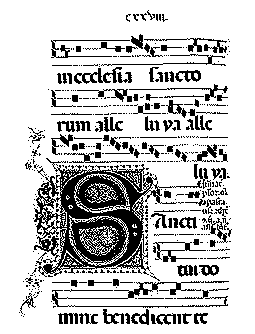
This module discusses the book in the Middle Ages in two parts: first, the manuscript book, how it was made and reproduced; second, "the book" in a figurative as well as literal sense as an instrument of power, prestige, change, and literacy. (Sections 1 and 2 of the Narrative are based on texts by Graham D. Caie, with research assistance by Stephen Harris.)
Contents:
Part 1: The Nature of the Book in the Middle Ages
Part 2: How a Medieval Book Was Made
Part 3: Christianity as a Religion of the Book
Part 4: Books and Literacy in SEAFARER Texts
You can skip to any one of these parts by clicking the appropriate button at right; the Contents below will bring you back to this list.
To learn about the Links and Images that accompany this narrative, click on the appropriate hyperlink. We recommend that you consult So What? after you have read one or two parts of the narrative below. Note that the sources used in the narrative are listed in the Bibliography and are cited here only by author and page or by author, title, and page.
The concept of a book in the Anglo-Saxon period--indeed up to the invention of printing in the Renaissance--was different from ours today. We will focus on two differences. First, every book was unique, written by hand--hence the word manuscript (manu, hand, and scripta, written)--on materials that had been prepared by hand. Even when material in two books was the same, there were differences created by the scribes who produced them. In addition to the scribe or scribes, book production involved a compiler, who was responsible for collecting the items and determining the layout or "mise-en-page" (literally, the "page setting") of the items, including the positions of illustrations and ornamentation. There were also artists responsible for those decorations--illuminations, illustrations and decorated capital letters--and finally the book binder. Other scribes were involved, too, since books written by hand were invariably copied by hand, and the copyists would add their own variations (errors) to those in the copy before them, although they tried to copy carefully and accurately.
Books were also distinguished by the wishes, needs, and interests of the person or persons commissioning them. That person might have been a bishop wishing to collect in one volume copies of laws, sermons and prayers, or an abbot who wanted copies of the major biblical texts in his monastery library. One book could contain many texts, and if they pertained to a theme the book would be known as a florilegium . But its status depended on the status of the person who caused it to come into being. (LINK01 suggests that you look at other ways of organizing presentations on the book.)
The majority of Anglo-Saxon books were made in the monastery's scriptorium (you might have read about or seen one depicted in the film version of The Name of the Rose). The copying of books and thereby the preservation of divine knowledge was seen by a many monastic orders as a one of their major functions, a sacred task rather than a chore, a spiritual act akin to prayer, although copying books was sometimes included in monastic rules among the monks' physical labors. The sacred nature of the work justifies the great labor and expense that went into the preparation of the beautiful manuscripts such as the Lindisfarne Gospels or Book of Kells. This sacred character also explains the anonymity of most medieval books. God was the author of all knowledge, and an individual writer's originality counted for very little. Few scribes or authors are known to us, largely because of the concept of the author as one who passes on biblical and patristic knowledge of his predecessors. There was great concern that the humanity of the authors (the auctores) of sacred books would undermine the authority (the auctoritas) of their writings. The logos or word was sacred, and the writing of books, in particular of a theological nature, transmitted sacred doctrine. The scribe or translator of a medieval book was sometimes pictured in a setting that depicts the divine source of his revelation--with, for example, a dove or another small figure speaking into his ear. LINK02 explores the relation of this speaking figure to metaphorical ideas of writing.
There was a time when there were no manuscripts or books as we have been speaking of them here, although there were thousands of written documents. The book devolved from the custom of writing on ivory tablets or wax-smeared boards. Such a tablet was called a codex in Latin; codex now means "a book in manuscript," a handwritten book. Tablets usually had hollowed-out areas that could be filled with wax and written on, then smoothed over and used again. Several such tablets could be joined together by cord or metal rings and folded together. In the Middle Ages, texts were often transcribed first onto wax tablets and then onto permanent materials. The codex replaced the previously dominant system for storing writing, the roll , long strips of written material on which text was written and then rolled up. Rolls did all but disappeared when the more convenient codex appeared (just when this happened is a disputed point), but rolls in England were, in the twelfth century, the standard format for royal records. See LINK03 on the roll and its relation to the book.
Making a book required a writing surface made from animal skin that had to be carefully prepared, then shaped into book form, and then written on. We discuss these steps separately and start at the beginning of this process, with the sheep or calves whose hide provided the material used for manuscript pages, the membrane, often called parchment or vellum. We have already mentioned that most books were written in monasteries; monasteries were also places where the animals were raised who supplied the membranes--the skins--out of which books were made. The word parchment comes from the Greek city of Pergamenos and means "skin of Pergamon." This city is (myth has it) where the preparation of sheepskin for a writing surface was invented. "Parchment" is generally used to describe sheep membrane; vellum describes calf skin (the word comes from the Latin and Old French for is calf ). A sheep skin would be about 3 feet by 4 feet and calf skin larger, 4 feet by 6 feet. The larger skins were used for the enormous Gospels and service books called graduals (see IMAGE01) that would have large writing so as to be read in a dim church by a priest with impaired vision, or by members in a choir who had to read or sing from one book. Although paper was known from the East, and came to Europe in the already in the thirteenth century, it was not widely used there until the fifteenth century because it was originally not thought sufficiently durable; when paper was used, the outer, protecting leaves of a paper book would be of membrane. When paper began to gain in popularity, it was used for cheap textbooks; only membrane books could be used as security for a loan.
The preparation of membrane writing was a complex task. Sheets of membrane would be well soaked in a lime and alum bath for at least ten days, put on a frame and scraped of all hair and flesh, by a knife-like tool called a lunarium (so called because it is shaped like a half-moon). The membrane would be attached to the frame by strings tightened by pegs and pulled as it dried out. It would then be smoothed and whitened with pumice stone and chalk; the best sheets would have been more expensive and used for deluxe manuscripts. They might well have been bleached in the sun, and the finest were constantly scraped and rough spots carefully sanded with pumice. Good membrane was expensive. The Codex Amiatinus, a Bible made in England in the early seventh century as a gift for the Pope, took as many as 515 skins (McKitterick 140). See LINK04 for more on this book. There were some 170 books produced at the monastery of Tours in France in the ninth century, and they required somewhere between 5 and 60 skins each (statistics from McKitterick 140-41), giving some idea of the resources needed for book production in this period.
The skins of rabbits, pigs, deer and even small squirrels were also used, and it is suggested that the whitest, silkiest and smoothest came from the skin of unborn animals. The preparation was important if the scribe was going to make a good job on a smooth surface. If the membrane were not properly prepared it would become hard and brittle and crack after some time or curl into itself. Manuscripts still show the original holes where rough bits formed by scabs and other deformities had been cut out and cuts were sewn together in the cheaper membranes, which are darker and rougher than those used in deluxe manuscripts.
One side of the membrane was the hair side and the other the flesh side: the former still shows hints of follicles and is darker. The Anglo-Saxons treated membrane with the respect and care deserving of such a rare commodity. The schoolboy would not be allowed such an expensive luxury, but would practice on wax tablets that could be melted and reused, or slate, as was used even in this century. Often parchment was scraped of its first writing and reused and this is called a palimpsest.
Making pages: When the membrane was ready, preparation of the book could begin. The membrane would be folded in gatherings or quires unless just one sheet were to be used for a legal document. The method of making multiple writing surfaces from one membrane is easily demonstrated. One fold creates what is called a folio format, created when the bifolio, the single sheet, is folded and becomes two folios (bi-folio) with 4 sides. Folded again, the sheet becomes a quarto (8 sides, 4 pages); folded again, it an octavo format (16 sides, 8 pages). You can practice this with a piece of paper: take a piece of paper written on one side, and pretend that written side is the "hair side" of the membrane and the unwritten one is the flesh side (see IMAGE02).
The folded membranes were then gathered in quires, a "loose book," usually of four pages--the word quire comes from quattor, meaning four. Quires, also called gatherings (see IMAGE03 for a drawing), were usually grouped in eight leaves (that is, 4 bifolia) in insular manuscripts but they can have more if a single leaf were sewn in at some point, perhaps to replace a torn or lost page, or to add more text at a particular point in the manuscript. When the word page is used it refers to the modern method of pagination. Medieval manuscripts are numbered by the folios with a recto (meaning front or facing) or verso (reverse, behind) added later to specify whether So the references "folio 27r" refers to the front of folio 27, 27v to the back.
Ruling pages: The page would then be "pricked" and "ruled." Pin prick marks would be made around the margins to guide the person who would draw the lines--the ruling--on which the text would be written. A sharp stylus, the back of a knife or bone with metal tip would be used to rule the page so that an indentation was made without any coloured mark. The pin pricks would go through a number of folios and so uniformity could be ensured, and a frame or ruling board used to give uniformity to the ruling throughout the manuscript. Vertical lines would indicate the left and right hand margins and this is why today, even with computers, we like to see justified right-hand margins, even though these serve no practical use. One can often tell where the manuscript was prepared by the layout and ruling patterns. Spaces would be left for decorated initials, illuminations (with colored inks or gold leaf) and illustrations.
Writing: Often the manuscript would be written before the membrane was cut and made into a quire. How do we know? If this were the case then the scribe had to be very careful to know the sequence of the sheets. Here again a little practical experiment is useful. Take a piece of paper, fold it twice, write the numbers of what will become the "pages" on each, and then unfold. You will see in the unfolded paper how complex the numbering is on both sides of the now-opened sheet. Sheets of membrane have been found uncut, which suggests that this method might have been used, although most medieval illustrations show a scribe working on a bound codex.
Medieval scribes wrote with a variety of instruments. Pens were made of goose or swan feathers, sometimes from reeds, and if a very small script were required, from a raven or other, smaller, bird. The feather was stripped and left to dry for some time, then the tip was cut off at an angle. In medieval illustrations a scribe invariably has a knife in one hand and a quill in the other. The knife was constantly used to sharpen the quill which would also be exchanged for a new one at frequent intervals. The knife would also be used to scrape out errors, as the membrane, being thicker than paper, would not tear if carefully scraped. It is therefore easy to see where corrections of this type have been made. The pen was dipped in ink held in an inkhorn, often made from an animal's horn and allowed to hang by a thong from the desk. You will find a drawing of a scribe working with such a tablet in IMAGE04, taken from a manuscript of the Bible made in England in the early eighth century as a gift to the Pope. The illustration shows Ezra, an Old Testament priest or prophet holding a book open in one hand, with a stylus at his feet. An array of writing instruments, most of them used at the monastery at Whitby (north of Monkwearmouth-Jarrow), is pictured in IMAGE05. The tools include various kinds of styli (writing instruments) and a tablet hollowed out on one side to hold wax. IMAGE06, from the Lindisfarne Gospels, shows another scribe at work.
Most medieval ink has survived extremely well. It was made from lampblack, soot or charcoal to which gum was added. Tannic acid and ferrous sulfate made iron-gall ink. The tannic acid could be made from crushed oak gall, with wine or water added. Gum arabic would be added to make it thicker. Red ink was made from mercuric sulfide and white of egg with gum added for thickening. The headings on folios or tables or important words were often written in red ink, hence the name rubric, which comes from Latin work ruber, which means red.
Layout and design: Since a few manuscripts have blank spaces for and decorated capitals, we presume that the text was written first before the illustration. It would also appear that some illustrations were first sketched and the colors to be added later were noted by tiny letters on the sketch which were then used as instructions by the illustrator. The compiler would decide the position and number of the many possible decorations, which ranged from small decorated or foliated initials, flourished initials, painted borders, foliation [floral decoration], historiated capitals [with a scene painted into a capital], as well as illustrations and illuminations, so-called because gold was used and this gave off a reflected light.
Gold was forbidden later by the Cistercian order as an unnecessary luxury, but it was commonplace in other medieval manuscripts. It was often applied to the membrane before other colors, as the thin gold leaf had to be burnished or rubbed on to the membrane and this would otherwise have smudged the colored inks. The gold was beaten until paper-thin and the monks had to be careful that it did not blow away in draughty scriptoria. Glue is applied to the membrane, the gold leaf carefully placed on and the overlaps cut off and recycled. Sometimes a gesso or plaster substance is applied first so that the gold is raised up and catches the light better.
The other colors used were blue, made from lapis lazuli or azurite stone. As it had to be imported from the Middle East, it was precious, and was sometimes scraped off old manuscripts to be reused. Red came from mercuric sulfide, mercury and sulfur heated together to form the compound known as vermilion. Green came from verdigris, yellow from saffron and white from white lead. LINK05 will lead you to additional information on color and costs.
The layout of a manuscript depends largely on its function. The vast liturgical books used in the divine office would have large writing, but the majority of works used every available inch of space because membrane was so valuable. Manuscripts were turned into palimpsests by scraping away text so that new texts could be written on old surfaces. In a gathering a folio might be cut out if the item were completed; a new item might begin immediately after the preceding one, and the script, although invariably clear in Anglo-Saxon manuscripts, was economically small. Poetry was written out continuously as prose. This last fact has probably less to do with preserving space than the fact that prose and poetry were not as strictly differentiated as they are today; a homilist, for example, might well write what is often called "poetic prose" or "rhythmical prose," that is, prose that observed (irregularly) the meter of verse.
Sewing and binding. In the last step of making the book, the gatherings and quires would be sewn together eventually and attached to leather thongs which in turn were attached to the wooden boards to be used as a binding. These thongs or cords pulled horizontally across the spine would create raised strips, still seen in books of the last century. Then a fine leather cover would be molded on to the entire binding to give it a smooth finish. These bindings would be decorated by leather work, gold or inlaid jewels, but we have unfortunately few examples of Anglo-Saxon book bindings, sometimes because they were richly decorated with jewels and were stolen. One Bible, stolen by the Vikings and all its jewels plundered, returned to England without its covers. The famousExeter Book that contains much of the extant Old English poetry, such as "The Wanderer," "The Wife's Lament," and "The Seafarer," has no original binding, and was used as a bread board, as the cut marks on the cover testify.
Many manuscripts are richly glossed. Some Latin works have an interlinear gloss in Anglo-Saxon, others have marginal glosses giving sources or comments. The manuscript of the Colloquy in the TEXT section of SEAFARER shows that the Old English is actually an interlinear gloss on a Latin text. IMAGE07 shows you a small section of a glossed manuscript. Glossed manuscripts could have extremely complicated layout schemes if the copyist was working from a manuscript that was already glossed. Otherwise the glosses were written wherever space could be found.
We have already mentioned the large, liturgical tomes of folio size. They were Gospels, Lectern Books such as Lectionaries and Graduals (instructions for the sung portions of the mass). Slightly smaller were academic bibles--used in 12th and 13th centuries for educational use by the Dominicans--and portable Bibles. There were also collections of Saints' Lives or Hagiographies, Breviaries (with the divine offices for specific days), processionals with hymns and chants for liturgical processions, and missals (with the liturgy to be said by the priest at the altar). Private books included the beautifully illustrated Books of Hours (devotional or canonical 'hours' of the day, that would include psalms). These became best-sellers and were gorgeously illustrated, so one wonders if the owners used them to follow the canonical hours or for their beauty. The best known is the Tres Riches Heures du Duc de Beurry. Others include meditations and prayers, homiliaries (collections of sermons), books on penance, confessionals and works of a mystical nature: there were also Bible stories, concordances, florilegia, and books of exempla.
In addition there were practical books of recipes, cures and other medicines, treatises on topics such as falconry, heraldry and hunting. Some of these books were comparable to "pocket books," or handbooks, and could be carried around easily; the "girdle book" (IMAGE08) is an example. One of the most popular was the Commonplace Book, which was really a collection of all the material one person would like collected -- a personal library in one volume that had no organizing principle other than the interests of the commissioner. Finally there were teaching books on grammar, and, in the later Middle Ages, Latin translations of classical authors such as Aristotle and Plato. Towards the end of the medieval period, illustrated and illuminated collections of entertainment, such as Chaucer's poetry, were commissioned.
Almost every phase in the physical process of preparing the manuscript book gives us valuable information about specific scriptoria that can be used to localize manuscripts to their place of origin. We can usually locate and date a manuscript by the handwriting, and we call this the science of paleography . But other data, such binding, page layout, and so forth, also help identify the provenance of manuscripts. In the centuries when Old English was either a lost language or considered unimportant (that is practically from the 12th century to this century) the books were badly treated and poorly preserved. It is probable that hundreds of books were lost in the mid-sixteenth century when King Henry VIII dissolved the monastic holdings of the Church in preparation for the establishment of the Church of England. Many more manuscripts were lost in a fire in the library of Robert Cotton in 1731. LINK06 gives you an opportunity to study the fate of Old English books in the Renaissance.
It is easy, when thinking about an item so routine in our culture as a book, to take for granted the impact of books on cultures in which they were (and, in some places, still are) rare. Books imply literacy--the ability and read and write--and literacy brings with it the stratification of societies into layers determined by literacy skills. It is also easy to forget that there are non-written or oral texts, and that there are still societies in which oral rather than written communication predominates. When such cultures begin to be influenced by writing and eventually by the book, they invariably change. Changes of this kind have become the focus of exciting work in the discipline of anthropology.
Jack Goody is an anthropologist who has examined orality and writing imply different means of organizing and retaining knowledge. Goody uses the phrase "the logic of writing" to describe the impact of writing on how societies perceive "the word," by which he means revealed truth of religion and myth. "The word" is written in what Goody calls "religions of the book," but it is not written in all societies, some of which preserve their central core of beliefs orally instead. Christianity is undoubtedly a religion of the book. In Illiterate America, Jonathan Kozol notes that "from early centuries, the Hebrew people have been known as 'People of the Book' (140). An example of a religion that is not, that depends on oral narratives instead, is that of the Zuni Indians (or the Aashiwi) of western New Mexico, which were recorded and transcribed--thus becoming books for the first time--only in 1964-66. LINK07 discusses the Zuni texts; you should compare the ideas here to the famous story of the poet Caedmon discussed by Bede. In Bede's History and in other SEAFARER texts we have abundant evidence that the introduction and management of the book in Anglo-Saxon society was a momentous event. This was true not only because a new technology--writing--had taken over the transmission of knowledge and reorganized knowledge, but also because the new religion had to deal with the systems of the old one. The conflict between the two tells us a good deal about both kinds of literacy.
"Literate religions," Goody writes, " . . . are generally religions of conversion, not simply religions of birth. You can spread them, like jam. . . . In fact, the written word, the use of a new method of communication, may itself sometimes provide its own incentive for conversion, irrespective of the specific content of the Book" (Logic 5). These incentives are related to power: the priests of the new religion can read, and those discovering this religion (the prospective congregation of converts) find that they too can learn this skill. Goody characterizes religions of the book as concerned with boundaries--laws, regulation, specific practices--that writing preserves and enforces. Religions in societies without writing are bounded by the people who observe them: "You cannot practice Asante religion unless you are an Asante; and what is Asante religion now may be very different from Asante religion one hundred years ago" (5). This is because the Asante themselves changed greatly from one period to the next, and inevitably also changed their practices and beliefs, even while retaining "the word" of their religion.
We want to use this association of literacy with power and conversion to look at some of the important ways in which books changed early medieval society. It is worth considering Christianity in this context because, although in the Middle Ages it was a bulwark against foreign invasions, it was itself an invasive religion, one of a number of religions that entered the Roman Empire as a result of the Empire's expansion. One topic central to this change is the administrative use of documents. In SEAFARER texts, the concern with written documents is particularly evident in the Life of King Alfred. Alfred not only learned to read himself (it is very doubtful that he wrote in the sense of holding a pen, however) but stimulated the large-scale production of books in England at the end of the nine century. It is evident that the written word was particularly important to him, not only to spread knowledge and learning--although this was of course a paramount aim--but also to establish firm control over his territories and his bishops. LINK08 will get you started on Alfred's use of writing and book production. We are tempted to survey Alfred's translations of important (and some not-so-important) Latin texts from a strictly humanistic perspective, lauding (rightly enough) the king's concern with perpetuating wisdom among his people. See LINK09 for work on letters and their importance in this period.
But writing, as Goody and other scholars have shown, has other aims, more clearly practical and political, and directly related to economics. Legal transactions were witnessed in writing; charters were written to determine land boundaries and ownership, and of course wills were written with similar aims of clarity in mind. Consult Whitelock's section on Charters, Tracts, and Wills for examples of documents of this type.) Charlemagne sent out emissaries to take inventories of books in church libraries because books were an indication of wealth and status of several kinds--figurative and literal (see McKitterick 148-64 on Books As Wealth). Book inventories--writing about writing--are important evidence for modern scholars interested in learning about the relative wealth of various medieval monasteries and the location of particular texts. Here again Alfred's laws are crucial evidence, since his is the first written code and since it makes a point of summing up (indeed, incorporating) previous codes into itself.
We take the existence of clerical literacy and books for granted in ecclesiastical culture, often reading these texts without due regard for the literate processes they are implicitly describing or enacting. We think of books existing to be read in the way we read them--for entertainment, for reference, or for study--without remembering that books represented the world of knowledge and tradition, cumulative authority, in the medieval period.
For whose benefit were these books and all this writing about books undertaken? "The effective use of written documents demands a minimum of intellectual training", writes F. L. Ganshof, a pioneer in the field of the administrative use of medieval books (135), and his comments leads us to a topic that will become a SEAFARER module of its own, education. In the Anglo-Saxon context, we have evidence in Asser's Life of Alfred that education was essential for young men raised in well-born families. Women from good families were also educated, as the Life of Leoba shows, and the existence of Hild and other abbesses in Bede's History tells us. Education of the laity, therefore, was largely confined to its upper reaches (as we would expect). Education was carried out in monastic schools and in the home. Recall Asser's story about Alfred learning to read (to memorize, at any rate).
1/98